City - Beijing
A city is not observed from outside. It is continuously recomposed by the bodies, climates, movements and contradictions that pass through it.
2011 · Interactive audiovisual work · 6′50″
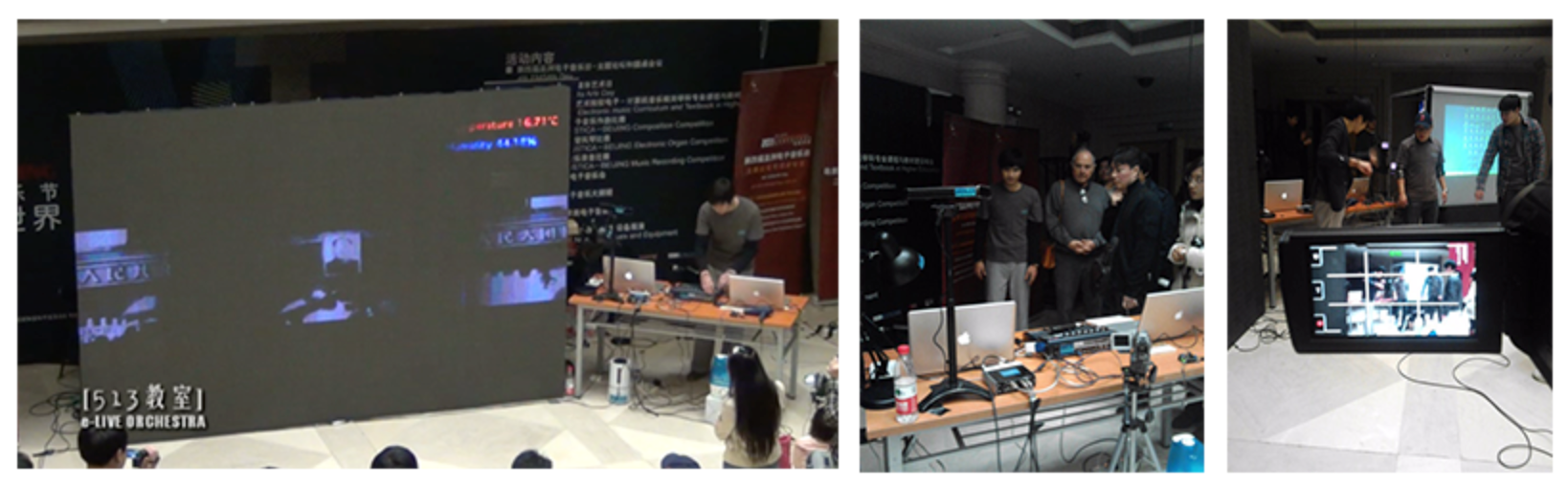
City - Beijing is an interactive audiovisual work constructed from documentary DV footage, bodily movement and environmental sensing.
Sensors register light, temperature and humidity. These inputs transform moving footage and sound in real time through Max/MSP/Jitter, Csound.
A City Made Through Participation
Interaction is the central structure of the work.
A gesture can alter the movement, visibility and organisation of the video. Changes in light, temperature and humidity enter the system as compositional information. Conditions that normally remain in the background of perception become active forces within the audiovisual field.
The body is therefore not placed in front of an already completed city. It enters the process through which the city is continuously reconstructed.
Many Beijings Within One Visual Field
The DV material moves between sharply different urban situations: the commercial spaces of Sanlitun, monumental public spaces, old tree-lined streets, the Bird’s Nest and Water Cube, crowded shopping centres, summer heat, and the continually accelerating movement of metropolitan transport.
These scenes are sliced and masked, covered by noise, distorted and blurred, and shifted between different speeds and layers. At times, the moving image appears as a continuous flow; at others, it breaks into fragments, interruptions and unstable visual layers.
Yet these changes do not occur arbitrarily. City - Beijing is a complete performed work with a strict sectional structure. Moving image, sound and interactive materials are organised according to clear temporal relationships, developing continuously through the establishment, accumulation, transition and release of tension. The real-time system remains open throughout, while the work’s overall structure, material relationships and sonic direction remain under precise control.
Real-Time Visual and Sonic Transformation
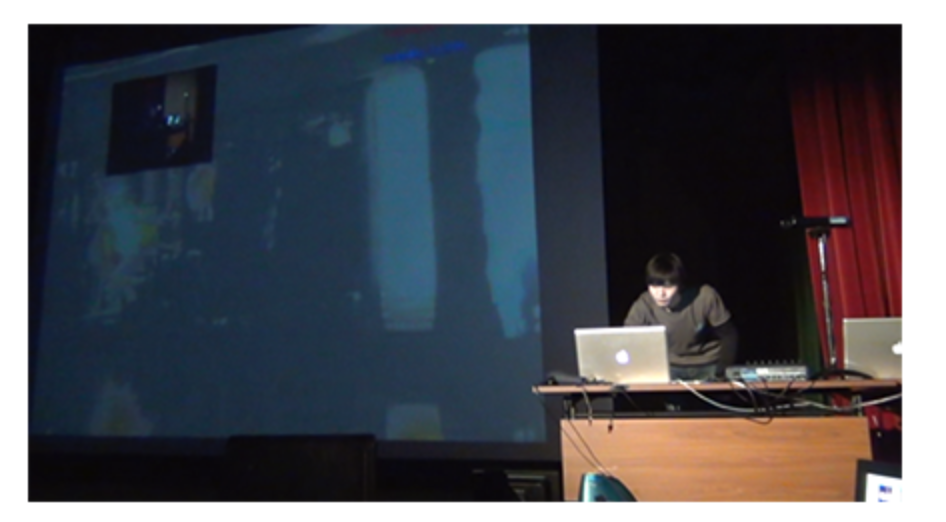
All visual and sonic changes are generated in real time.
Max/MSP/Jitter processes the DV moving image through slicing, masking, noise, distortion, blur, temporal displacement and changes of speed. Csound and MSP generate and process sound through granular synthesis, FM modulation, transformed samples, and distorted rhythmic and percussive materials.
They belong to the same real-time system and continuously modulate one another throughout the performance. Changes in sonic density, spectrum, rhythm and dynamics affect the movement, clarity, switching speed and spatial organisation of visual forms; changes in the visual system, in turn, participate in the control and response of sonic parameters.
Kinect-based motion capture and the light, temperature and humidity sensors enter this feedback structure together. Bodily movement can alter sound and visuals simultaneously, while environmental data also modulates the behaviour of both. A gesture or environmental change does not merely trigger a single effect; it reorganises the relationships among sound, moving image and temporal structure.
Therefore, interaction in the work is not a control mechanism added outside the music and visuals. It is itself part of performance, composition and structural development.
Order, Disorder and Contemporary Urban Experience
The work presents the city as a condition in which order and disorder remain inseparable.
Architecture, traffic, crowds, climate, individual movement and technological systems appear to operate together, but never in complete agreement. Moments of rhythm and coordination coexist with interruption, friction and instability.
This contradiction is not treated as something to be resolved. It is the material of contemporary urban experience.
City - Beijing does not offer a final conclusion about the city. It constructs a temporary perspective—one produced through moving image, sound, climate, software and the body present at that moment.
Work Archive
- Title
- City - Beijing
- Year
- 2011
- Duration
- 6′50″
- Form
- Interactive audiovisual work
- Creator
- Composition, programming and video production by Liu Hao / 刘昊
- Moving-image material
- DV footage of Beijing
- Interaction
- Light, temperature and humidity sensors; Kinect-based gesture input
- Visual system
- Max/MSP/Jitter
- Sound system
- Csound and MSP; granular synthesis, FM modulation, transformed samples and processed rhythmic materials
- Core structure
- Strict sectional structure with real-time moving image, sound and interaction
- Presentation
- Central Conservatory of Music, Beijing, 2011
- Documentation
- Performance photographs and original project brief